

Table of Contents
Your competitors are outmarketing you because they’ve tightened their ICP, lead with a clear outcome-based promise, and run a repeatable demand system with clean attribution. You’re likely spreading spend across channels and funnel stages, tracking vanity metrics instead of pipeline velocity, win rate, CAC-to-LTV, and payback. Fix it by auditing share of voice and channel mix, choosing one funnel stage to win, improving message match on landing pages, and using proof-heavy follow-ups. Keep going to see the 30-day plan.
Key Takeaways
- Competitors win by targeting a sharper ICP and tying messaging to measurable outcomes, not feature checklists.
- They run repeatable demand systems with clean attribution, prioritizing channels with the best CAC-to-LTV leverage.
- They build stronger differentiation using a clear category narrative that pre-handles objections with promise–proof–path messaging.
- They align content and offers to a single funnel stage, answering buyer questions with the right proof at each step.
- They optimize for pipeline velocity and win rate, iterating weekly on CAC, payback, MQL-to-SQL, and sales cycle length.
Why Competitors Outmarket You (The Real Gaps)

Although it may look like your competitors simply “post more,” they usually outmarket you because they’ve closed a few specific execution gaps: they’ve defined a sharper ICP, built messaging around measurable customer outcomes, and run a repeatable content-to-demand system that ties channels, offers, and follow-up to revenue.
Your gaps are rarely creativity; they’re consistency and proof. You talk features while they quantify impact (time saved, risk reduced, revenue gained) and use that evidence everywhere.
You spread efforts across channels; they pick the few with the highest CAC-to-LTV leverage and instrument them with clean attribution.
You chase reach; they engineer Brand differentiation by owning a specific category narrative and objection-handling.
You measure vanity metrics; they optimize for pipeline velocity and win-rate.
Over time, that focus compounds into Customer loyalty because buyers know exactly why you win and what outcomes you deliver.
Run a Competitor Marketing Gap Audit
Run a competitor marketing gap audit by mapping where rivals show up—search, paid, social, email, partners—and measuring which channels actually capture your customers’ attention and intent.
Compare their content topics, formats, and funnel stages against your buyers’ top questions to spot coverage gaps and under-served use cases.
Then prioritize the highest-impact content opportunities where demand is proven, competition is thin, and you can win with clearer value and stronger proof.
Map Competitor Channels
Before you try to outspend or outpost your rivals, map exactly where they’re winning attention—and where they’re leaving demand untouched. Build a channel inventory for each competitor: paid search, organic search, social, email, affiliates, marketplaces, partnerships, events, and PR. Pull concrete signals—share of voice, impression share, referral sources, follower growth, ad frequency, and estimated traffic by channel—to see what’s driving pipeline, not just likes.
Then benchmark your mix against customer journey stages. If they dominate high-intent search but ignore community, you’ve found leverage for Channel diversification. If their reach spikes around product launches, trace it to Influencer collaborations, co-marketing, or reseller programs.
Prioritize channels where your ICP already converts and competitors underinvest, then set targets and tests.
Identify Content Opportunities
Where are your competitors answering buyer questions better than you—and where are they not showing up at all? Run a marketing gap audit that compares your content to theirs by funnel stage and intent: awareness (problem education), consideration (comparisons, ROI, integrations), and decision (pricing, security, onboarding).
Pull keyword rankings, SERP features, and top-performing pages; then map each asset to the question it resolves. Note missing formats: calculators, templates, short demos, customer proof. Track engagement signals—time on page, shares, email CTR—to spot topics that convert, not just attract.
Look for Influencer collaborations your buyers trust and evaluate their reach versus yours. Finally, review Community engagement in forums, reviews, and social threads to capture unanswered objections and create content that closes them.
Pick the Funnel You’ll Compete In
After your gap audit, you’ve got to choose the one funnel stage you’ll compete in first—awareness, consideration, or conversion—based on where you can move customer metrics fastest.
Then you align every asset to that funnel’s job, from the questions prospects ask to the proof they need to buy.
When your content maps tightly to intent, you reduce wasted spend and outperform competitors with fewer, sharper moves.
Choose Your Primary Funnel
Although you could spread your effort across every channel, you’ll win faster by choosing one primary funnel to compete in and measuring it like a P&L. Pick the funnel that matches your buyers’ decision path and your strongest constraint: traffic, conversion, or retention.
Use market segmentation to choose a single ICP slice with the highest LTV-to-CAC potential, then forecast volumes and break-even points.
Define inputs you control (budget, touches, sales capacity) and outputs you’ll track weekly (CAC, LTV, payback, win rate, pipeline velocity).
Commit to one core acquisition motion—search, paid, partnerships, outbound, or product-led—based on where your segment already spends attention.
Anchor your differentiation with brand storytelling that reinforces why you’re the safest, fastest, or most profitable choice.
Align Content To Funnel
Because your buyers don’t consume content randomly, you need to map every asset to the exact funnel you’ve chosen and the decision they’re trying to make. Audit your library and tag each piece by stage, intent, and next action. If a post can’t move a buyer forward, cut it or rewrite it.
Use Audience segmentation to align messages to the jobs-to-be-done of each segment, then apply Content diversification to match preferred formats: short video for discovery, comparison pages for evaluation, case studies and ROI calculators for decision.
Track stage-level KPIs—CTR to product, demo-start rate, sales-cycle velocity—not vanity reach. You’ll spot gaps (no middle-funnel proof, weak bottom-funnel objections) and prioritize the assets that win the funnel you’re competing in.
How Competitors Choose a Tighter ICP
Top competitors don’t “go broad” and hope the market sorts itself out—they tighten their ICP by cutting the addressable universe down to the segments that produce the highest win rates, fastest sales cycles, and lowest churn.
You can see it in how they define “best fit” with numbers: conversion rate by segment, payback period, expansion revenue, and support cost per account.
They start with Market research to map category demand, buying triggers, budget ranges, and alternative solutions, then validate assumptions in pipeline and product data.
Next, they run Customer segmentation on firmographics, technographics, and behavior to isolate clusters where messaging resonates and procurement friction drops.
Finally, they codify exclusion rules—deal breakers, poor retention profiles, and low-LTV use cases—so sales and content stop chasing noise and focus on measurable outcomes.
Find Competitors’ Highest-Converting Channels
Where are your competitors actually getting customers—not just clicks? Start with Market analysis across paid, organic, partner, and outbound channels. Pull their traffic sources from Similarweb, their ad density from Meta/Google libraries, and their SERP footprint from Ahrefs or Semrush.
Then validate conversion intent: track lead magnets, demo flows, and checkout paths, and note which channels consistently push prospects into high-commitment actions. Use Audience segmentation to map each channel to who it attracts (job roles, firm size, use case) and the stage it serves.
Compare this to your own funnel data: CAC, MQL-to-SQL rate, win rate, and sales cycle length by source. Double down where competitors show repeatable, profitable motion. Cut noisy channels and reallocate spend fast.
Why Competitor Messaging Sounds Instantly Clear
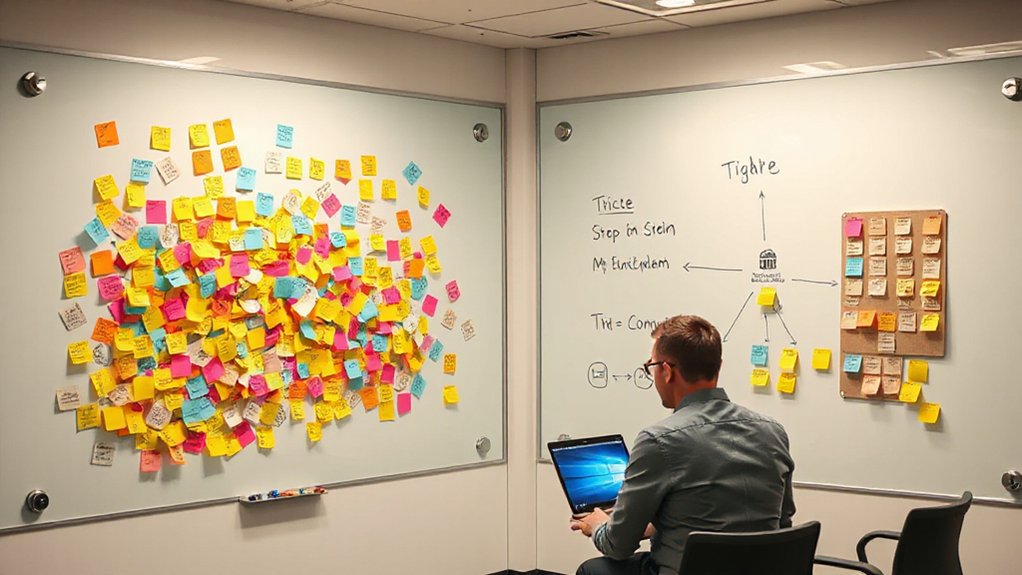
Although it feels like your competitors “just have better copy,” their messaging sounds instantly clear because they’ve engineered it around a tight promise–proof–path structure: one primary outcome they deliver, the evidence that makes it believable, and the next step that reduces buyer risk.
You’re hearing signal, not noise: a single customer job-to-be-done, quantified where possible (time saved, error reduced, revenue gained). Their proof stacks fast—benchmarks, logos, testimonials, and specific use cases—so your brain updates confidence in seconds.
Then they make the path obvious with low-friction offers, clear onboarding, and transparent pricing cues. Brand storytelling ties those elements into one narrative you can retell.
Visual branding reinforces it with consistent hierarchy, screenshots, and before/after visuals that compress complexity into instant understanding.
Turn Competitor Insights Into a 1-Line Position
Clear competitor messaging comes from a repeatable promise–proof–path formula, so your advantage starts when you translate what you’ve learned into a single line you can defend.
Pull the top three promises competitors make, then map their proof (metrics, logos, outcomes) and path (how they deliver).
Now find the whitespace: which customer job remains underserved, which proof is weakest, and which path feels slow, risky, or expensive?
Write your 1-line position as: “For [ICP] who need [job], we deliver [promise] with [proof], unlike [alternative], because [path].”
Stress-test it against call notes, win/loss data, and funnel conversion rates.
If it lifts reply rates or demo-to-close, you’ve locked Market positioning and Brand differentiation into one line.
Build a Simple Competitor-Proof Content System
You don’t outmarket competitors by publishing more—you win by running a repeatable content workflow that turns customer questions and performance data into predictable output.
You’ll standardize intake, drafting, review, and distribution so every asset maps to a measurable funnel goal and a clear customer outcome.
Then you’ll lock in a refresh-and-repurpose cadence that updates proven winners and converts them into new formats, keeping your message consistent while competitors scramble.
Repeatable Content Workflow
How do top-performing teams publish consistently while competitors scramble? You win by turning content into an assembly line: define inputs, owners, and exit criteria for every stage.
Start with audience segmentation in your CRM and analytics, then map each segment to a single job-to-be-done, primary KPI, and proof point.
Build briefs from a template, not a blank page, and lock a weekly cadence for ideation, draft, review, legal, and publish.
Use Content automation to route tasks, enforce SLAs, and capture performance metadata at publish time.
You’ll cut cycle time, reduce rework, and ship messages that match real customer intent.
Measure lead quality, not clicks, and iterate the workflow, not just the topics.
Refresh And Repurpose Cadence
Even if competitors copy your topics, they can’t easily match a disciplined refresh-and-repurpose cadence that compounds performance over time.
Build a calendar that schedules Content refresh at 30, 90, and 180 days for every asset, triggered by ranking drops, conversion dips, or product changes. Update the intro, add new proof points, tighten CTAs, and improve internal links so customers get the latest answers fast.
Then run a Repurpose cadence that turns each refreshed core piece into a webinar segment, sales enablement one-pager, two LinkedIn posts, and an email sequence.
Track lift in impressions, CTR, and pipeline influenced; keep what moves buyers forward. This system makes you faster, more consistent, and harder to outmarket because every update increases reach without restarting from zero.
How Competitors Repurpose Content Faster Than You
While your team’s still polishing a single blog post, competitors are already turning that same idea into a week of customer-facing assets—short videos, email segments, sales enablement slides, and SEO snippets—because they’ve built a repurposing system, not a one-off production cycle. They run Content repurposing like a pipeline: one core insight, modular components, and predefined templates mapped to each channel.
You’re slower when every asset starts from scratch and approvals happen in sequence. They use Speed optimization: parallel workflows, clear owners, and tight SLAs for editing, design, and distribution.
They also instrument performance—watch time, CTR, keyword lift—then recycle the top 20% into new angles customers actually search for and share.
If you want to catch up, standardize formats, create a content matrix, and batch production weekly.
Why Competitors’ Offers Convert (And Yours Don’t)

Speed wins attention, but your offer wins (or loses) the conversion. Competitors convert because they match the offer to intent: a clear outcome, a specific audience, and one frictionless next step.
You often lead with features; they lead with measurable value and proof. They tighten the promise with constraints (time, scope, eligibility), so buyers can self-qualify fast.
They package risk reversal—trials, guarantees, transparent pricing—so hesitation drops. They also stack evidence: benchmarks, customer logos, case metrics, and third-party validation that builds Brand authority and accelerates Customer trust.
Finally, they align the offer to the buying committee: ROI for finance, time-to-value for ops, security for IT.
Audit your top funnel sources, map intent, then rewrite your offer around outcomes, proof, and reduced risk.
Fix Your Landing Page to Capture Demand
When your ads, posts, and referrals generate intent, your landing page either converts that demand into pipeline or leaks it through confusion and friction. Audit it like a funnel: message match, speed, and clarity.
Your headline must restate the exact promise from the ad, then prove value in 5 seconds with Visual storytelling (product-in-use, before/after, short demo clips).
Cut choices: one primary CTA, one form, and only the fields sales truly needs. Add specificity—who it’s for, what it replaces, and outcomes with numbers.
Use Customer testimonials that mirror your target segment and highlight measurable results, not praise.
Reduce risk with security, pricing guidance, and implementation expectations.
Track scroll depth, form starts, and drop-off by device, then A/B test one variable at a time.
Write Follow-Up Emails That Close the Sale
Your follow-up email has seconds to prove value, so personalize the first line using what you know from their page behavior, role, or pain point.
Tie that insight to a specific outcome you can quantify, then keep the body tight and relevant to their decision criteria.
End with one clear next step—book a 15-minute call, reply with a number, or choose an option—so you reduce friction and move the sale forward.
Personalize Value In Seconds
Although most follow-up emails get ignored, a simple personalization layer can lift replies and shorten sales cycles because it ties your offer to the buyer’s specific goal in seconds.
Start by mirroring one concrete detail: their KPI, tool stack, initiative, or constraint. Then translate your benefit into a measurable outcome for that context (time saved, risk reduced, revenue protected).
This is personalized messaging that feels earned, not creepy.
Use a tight structure: 1) one-line recap of their stated priority, 2) one proof point mapped to that priority (metric, case study, benchmark), 3) one sentence of rapid value showing what changes if they act.
Keep it skimmable: short lines, bold numbers, and plain language.
You’ll outperform competitors who send generic nudges.
Use Clear Next Steps
Because most deals stall on ambiguity, you’ll close more follow-ups by giving the buyer a single, low-friction next step with a clear time box.
Instead of “Let me know,” propose one action: “Reply with 1 or 2 for Tuesday 2–3 pm, or I’ll hold next week.” Buyers decide faster when you reduce options and effort; your email should do the thinking.
Anchor the ask to outcomes you’ve already quantified: “This cuts onboarding time 18%” or “saves $4k/quarter,” then link directly to a calendar slot or one-click approval.
Add a micro-commitment: “If this isn’t priority, tell me and I’ll close the loop.” That respect builds Customer loyalty and signals Market differentiation.
You keep momentum without pressure.
The Only Metrics Competitors Actually Watch
If you want to outmarket competitors, focus on the handful of numbers they actually benchmark: share of search, pipeline velocity, CAC payback, conversion rate by channel, and retention. These metrics reveal whether you’re winning attention, moving buyers faster, and keeping revenue durable.
Track share of search to validate Brand storytelling and influencer collaborations are expanding demand, not just impressions. Measure pipeline velocity to see if messaging answers real buyer questions and shortens sales cycles.
Watch CAC payback to ensure acquisition fits your cash constraints and customer LTV. Break conversion rate by channel so you can double down where intent is highest and fix leaks where it isn’t.
Finally, retention tells you if your product and onboarding deliver ongoing value—and whether growth compounds or churn erases gains.
A 30-Day Plan to Outmarket Your Competitors
Thirty days is enough to take measurable market share when you run a tight, metric-led sprint instead of a scattered campaign.
Days 1–3: benchmark CAC, conversion rate, retention, and share of voice; pick one ICP segment and one primary channel.
Days 4–10: ship two landing-page variants, tighten offer and pricing anchor, and instrument events.
Days 11–17: launch Brand storytelling that proves outcomes with customer data, not adjectives; repurpose into ads, email, and sales enablement.
Days 18–24: activate influencer partnerships with trackable codes, co-created demos, and whitelisted ads; optimize to pipeline, not likes.
Days 25–30: cut losers, double budgets on winners, and lock a weekly review cadence.
You’ll outlearn, outship, and out-signal competitors.
Frequently Asked Questions
How Do I Outmarket Competitors With a Smaller Budget?
You outmarket bigger-budget competitors by focusing spend on what measurably converts. Tighten Brand differentiation with one clear promise, then prove it through specific offers and case-study content.
Use low-cost channels you can iterate fast: SEO around intent keywords, email sequences, retargeting, and partnerships.
Drive Customer engagement with segmented onboarding, surveys, and community touchpoints.
Track CAC, LTV, and conversion rates weekly, cut losers quickly, and scale what wins.
When Should I Hire an Agency Versus Building an In-House Team?
Hire an agency when you need speed, specialized skills, or rapid testing you can’t staff in 60–90 days.
Build in-house when you need tight Brand voice control and always-on Content strategy.
If spend is volatile or you’re exploring channels, an agency reduces fixed costs and adds benchmarks.
If you have stable demand, repeatable workflows, and clear KPIs, hire operators who own customer insights and iteration.
What Tools Best Automate Competitor Tracking Without Being Time-Consuming?
You’ll automate competitor tracking best with tools like Visualping or Hexowatch for site changes, Brandwatch or Mention for social listening, and SEMrush or Ahrefs for SEO/PPC shifts.
Teams using automation cut monitoring time by 60%, giving you a clear benchmark. Set Real time alerts for pricing, ads, and content launches, then use Data visualization in Looker Studio dashboards to spot trends fast and act on customer needs sooner.
How Do I Avoid Copying Competitors While Still Learning From Them?
You avoid copying competitors by using them as benchmarks, not templates: extract patterns, then build Unique branding around your customers’ unmet needs.
Run Ethical research—review messaging, funnels, and pricing—then test differentiated hypotheses with A/B experiments.
Track what lifts conversion, retention, and CAC, and document your “do/don’t” playbook.
You’ll adapt tactics (channels, cadence) while creating original positioning, voice, and offers that match your audience. Consistently.
How Long Until Marketing Improvements Show Measurable Revenue Impact?
You’ll usually see measurable revenue impact in 8–16 weeks, though it can arrive sooner with paid spend and later with organic.
Think of the first month as “quiet traction”: you build Content consistency, tighten targeting, and refine Brand storytelling.
By weeks 4–8, you should see leading indicators—higher qualified traffic, conversion rate, and pipeline velocity.
Conclusion
You don’t lose because you’re invisible—you lose because your competitors close gaps faster. When you audit their funnel, tighten your ICP, and double down on their best-converting channels, you stop guessing and start reallocating budget to what performs. Fix your landing page to capture demand, then use follow-up emails that move prospects from “maybe” to “yes.” Track only pipeline, CAC, and conversion rate. Do this for 30 days, and you’ll move the needle—the ball’s in your court. If your marketing goals and expectations are sensible, you will succeed.