
Table of Contents
More than half of Google searches now end without a click, which means your page can “win” and still lose traffic. If you want AI answers and featured snippets to quote you, you can’t bury the definition, the steps, or the comparison—put the extractable answer first, format it like a snippet, and back it with credible entities and sources. The problem is choosing the right SERP feature and structuring for it without cannibalizing intent…
Key Takeaways
- Map each target query to the dominant SERP feature and intent type, then choose one primary feature to win.
- Lead with a quotable, definition-first answer that matches query phrasing, then add brief scope qualifiers for precision.
- Structure sections with scannable H2/H3 headings, concise paragraphs, and parallel lists or numbered steps aligned to “how-to” intents.
- Use labeled tables for comparisons and quick facts, placing them directly under relevant headings with consistent units and clear columns.
- Add intent-matched JSON-LD schema (FAQPage, HowTo, Article) aligned to on-page copy, and track impressions and snippet ownership in GSC.
Understand Zero-Click Search and AI Answers
Because Google increasingly answers questions directly on the results page, a growing share of queries now end without a click—your visibility depends on how you show up in SERP features like featured snippets, People Also Ask, knowledge panels, and AI-generated answers.
You’re no longer competing only for clicks; you’re competing for extraction. AI answers synthesize multiple sources, so you need tight topical coverage, clean structure, and unmistakable entities to be selectable.
Match user intent by mapping queries to tasks: definitions, steps, comparisons, and quick facts. Then reinforce contextual relevance with precise headings, concise lead sentences, and consistent terminology that aligns with the query’s language.
Watch how SERPs shift by device, locale, and freshness, since answer formats and citations change. Treat impressions, snippet ownership, and assisted conversions as core KPIs.
Choose the Zero-Click Feature You’ll Target
You can’t win zero-click by targeting everything, so use SERP data to spot the highest-value features in your category—featured snippets, PAA, local packs, and AI answers—and map them to queries that actually drive pipeline.
Then match intent to format: definitions and steps for snippets, comparisons for tables, locations for local, and quick validations for PAA.
Finally, prioritize where you’ve got the best snippet win probability by weighing current ranking, competitor structure, and how often that feature shows up for your target keywords.
Identify High-Value SERP Features
Before you optimize a single page for zero-click, map the SERP features that actually steal (or redirect) clicks for your target queries—featured snippets, AI Overviews, People Also Ask, local packs, knowledge panels, and video/image carousels don’t all behave the same.
Pull GSC queries, cluster by SERP layout, and note which features trigger most often on page 1. Prioritize features with high impressions, stable triggering, and measurable attribution (snippet ownership, PAA visibility, local pack presence).
Use rank trackers or manual spot checks to log volatility and pixel depth; some placements sit above the fold and suppress organic CTR hardest.
If Voice search matters, focus on Featured snippets and concise answers, since assistants frequently source them.
Then pick one primary feature per query set and defend it.
Match Intent To Formats
Why chase every SERP feature when search intent already tells you which format will win the zero-click spot? Map queries to the SERP block they’re signaling.
If the query starts with “what is,” “define,” or “meaning,” you’re in featured-snippet territory—lead with a 40–60 word definition, then expand.
If it’s “how to,” “steps,” or “setup,” format for a numbered list with clear verbs and tight step titles.
If it’s “best,” “top,” or “vs,” structure a comparison table plus scannable pros/cons.
If it includes a location modifier, reinforce local pack relevance with NAP consistency and FAQ markup.
This is content optimization driven by user intent, not guesswork, and it keeps your page aligned with zero-click extraction.
Prioritize Snippet Win Probability
Once you’ve mapped intent to a SERP format, pick the zero-click feature you can realistically win—because not every snippet is equally contestable. Start by auditing the current SERP: is the featured snippet rotating, or locked by a government/brand authority? If it’s stable, shift to People Also Ask, a short definition panel, or a list snippet where structure beats authority.
Score targets by win probability: (1) SERP volatility, (2) your topical relevance, (3) content gaps, (4) markup eligibility, and (5) link/brand strength. Then align Keyword optimization to the exact query pattern and snippet length Google rewards.
Finally, optimize for user engagement signals that sustain the win: fast answers, scannable headings, and clean tables that earn long-dwell and fewer pogosticks.
Write Definition-First Zero-Click Answers AI Can Quote
Although zero-click SERP features can steal the visit, you can still win the query by leading with a clean, quotable definition that AI and Google can lift verbatim into snippets, panels, and voice answers.
Put the definition in your first 1–2 sentences, match the query’s phrasing, and name the entity or concept directly to increase Definition clarity.
Then add one sentence that nails scope: who it’s for, when it applies, and what it excludes. This boosts Answer precision and reduces misquotes.
Use measurable qualifiers when intent demands it (timeframes, thresholds, steps, regions), because SERP extractors favor concrete claims over vague promises.
Keep it neutral and citation-ready: avoid hype, brand mentions, or hedging.
If the query implies comparison, define the term first, then give the differentiator in a single tight line.
Format Headings for Snippet Extraction
To win featured snippets, you should mirror searcher intent with question-based H2s that match high-impression SERP queries.
Keep each heading descriptive and specific so Google can map it to a single, extractable answer block without ambiguity.
Maintain a clear hierarchy (H2 → H3) so crawlers and LLMs can parse sections fast and select the right snippet-worthy passage.
Use Question-Based Headings
When you turn section headings into the exact questions people type into Google (for example, “What is a zero-click search?”), you align your page with how featured snippets and “People Also Ask” boxes get extracted.
You’re matching SERP mechanics: Google parses interrogative H2s/H3s, then pulls the tightest answer block beneath them.
Mine your headings from real queries. Pull variants from Search Console, PAA expansions, and auto-suggest, then mirror the wording to hit intent.
Keep each question mapped to one outcome: definition, steps, comparisons, or troubleshooting.
For voice search, these natural-language questions help assistants select your answer verbatim, boosting readouts and snippet eligibility.
Then answer immediately under the heading in 40–60 words, so the extractor doesn’t hunt.
This structure lifts coverage across long-tail queries fast.
Keep Headings Descriptive
Because Google often lifts headings as snippet labels, you need descriptive H2s/H3s that state the takeaway, not vague section names like “Overview” or “Tips.”
Use intent-led formats that map to common SERP blocks—“Definition: Zero-click search,” “Steps to win PAA visibility,” “Zero-click vs organic click-through,” “Fix: impressions up, clicks down”—so the extractor can pair a clear heading with the answer beneath it.
Write headings that match query modifiers (“best,” “vs,” “how to,” “fix”) and mirror what you see in Featured Snippets and PAA.
Keep them scannable: 6–10 words, front-load entities, and include the outcome.
This improves content optimization by boosting snippet eligibility and lowers pogo-sticking through clearer expectations.
When your heading promises a specific answer, you earn faster clicks when they happen and stronger user engagement signals in Search Console metrics.
Maintain Clear Hierarchy
Although descriptive headings help Google pick the right snippet label, you’ll win more zero-click visibility by keeping a strict H2→H3→H4 hierarchy that mirrors how SERP extractors parse sections.
When you skip levels or stack multiple H2s for tiny points, you fragment topical clusters and reduce snippet eligibility.
Use one H2 per intent bucket (definition, steps, pricing, FAQ), then map supporting details to H3s and edge cases to H4s.
This visual hierarchy signals scope and reduces ambiguity for passage ranking.
Aim for 40–60-word blocks under each heading because snippet pulls often favor compact, self-contained answers.
Keep headings parallel (“How to…,” “Best…,” “What is…”) so the model detects patterns.
Finally, don’t bury key entities in paragraphs; place them in the heading to boost content clarity and extraction accuracy.
Use Lists and Tables for AI-Ready Summaries
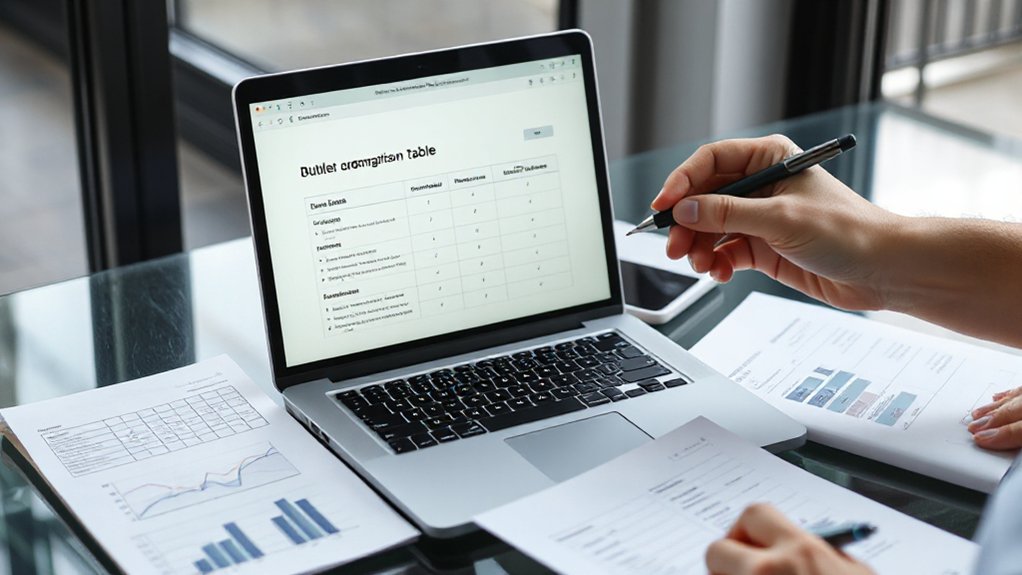
Two formatting choices—lists and tables—make your content easier for Google, AI Overviews, and chat-based assistants to parse, rank, and reuse in zero-click answers.
When the SERP intent is “quick steps” or “top options,” use numbered lists for sequences and bulleted lists for scannable takeaways. Keep items parallel, front-load entities, and cap each line at one idea to improve snippet lift.
For comparisons, add a simple table with consistent columns (feature, threshold, cost, timeframe). Use exact labels users search, and include units so the model doesn’t infer. Place the table directly under the answering H2, then follow with one-sentence interpretation for context.
This approach supports content optimization while boosting user engagement by reducing pogo-sticking and clarifying next actions.
Add Schema for Snippets (FAQ, HowTo, Article)
How do you get Google and AI Overviews to trust—and reuse—your answers at the top of the SERP? You add structured data that matches query intent and clarifies page purpose.
Implement FAQPage schema when you target “what/why” questions, HowTo schema for step-by-step tasks, and Article schema to define headline, dates, and key sections.
Keep JSON-LD aligned with on-page copy; mismatches can suppress rich results.
Use Schema customization to mark only the blocks you want surfaced: concise questions, numbered steps, and short answers.
For Snippet optimization, include explicit time, tools, or prerequisites fields in HowTo, and keep FAQ answers under 60–90 words.
Validate in Rich Results Test, then monitor SERP changes in Search Console.
Iterate weekly.
Get Cited: Entities, Sources, and E-E-A-T
In zero-click SERPs, Google and AI Overviews tend to reuse answers that attach to recognizable entities and verifiable sources. You win citations when your page clearly defines who, what, and where: brand, author, organization, product, and place. Use Entity optimization by aligning names, titles, and identifiers across on-page copy, schema, About pages, and profiles.
Strengthen source credibility with primary data, dated references, and transparent methodology. Cite authoritative publications, standards, and official docs; link to them near the claim, not buried. Add author bios with credentials, review processes, and editorial policies to signal E-E-A-T.
Match intent by answering with scoped definitions, thresholds, and constraints, then back them with sources. If you can’t verify a claim, remove it or qualify it.
Find New Zero-Click Queries and Refresh Pages
Citations don’t hold if your pages target the wrong SERPs, so you need a steady pipeline of net-new zero-click queries and a refresh loop for pages already showing up in featured snippets, People Also Ask, and AI Overviews.
Start with Keyword research that filters for SERPs dominated by answers: definition boxes, step lists, calculators, and comparison tables. Pull candidate queries from PAA expansions, “related searches,” internal site search, and support tickets, then map each to an intent pattern (how-to, troubleshooting, pricing, alternatives).
Prioritize topics where the snippet format matches your page type and where you can add a clearer, shorter answer block.
Run a monthly Content refresh on snippet pages: update dates, tighten headings, replace vague intros with direct answers, add missing entities, and revise steps to match current workflows.
Measure Zero-Click Wins (Citations, Impressions, SERP Features)
Three metrics tell you whether you’re actually winning zero-click search: citations (where Google or an AI Overview names you), impressions (how often you appear on answer-heavy SERPs), and SERP feature presence (which modules you own—featured snippet, PAA, AI Overview, knowledge panel).
Track citations by query and entity: count brand mentions inside AI Overviews and linkless attributions, then tie them to assisted conversions.
Use Search Console to segment impressions for pages that trigger “instant answer” intent, and watch deltas after updates.
Don’t overreact to falling click through rates; in zero-click, visibility is the win.
Audit SERP features weekly with a rank tracker: note which blocks you occupy, which competitors displace you, and what formatting shifts correlate with ranking signals.
Frequently Asked Questions
How Do Zero-Click Strategies Affect Email Signups and Lead Generation?
Zero-click strategies can reduce email signups by satisfying intent on-SERP, but you’ll boost lead generation when you add strong CTAs, User engagement hooks, and Content personalization that drive clicks to gated assets and tracking.
Can Zero-Click Optimization Hurt Brand Visibility or Reduce Trust?
Yes, zero-click optimization can hurt brand visibility or reduce trust if you trigger Visibility risks: incomplete snippets, misattribution, or outdated answers. You protect Brand trust by aligning snippet copy with pages, adding citations, and monitoring SERP coverage regularly.
How Should Content Teams Coordinate With PR for AI Snippet Mentions?
Like rowing in sync, you’ll align content and PR: map SERP intents, share a snippet claim sheet, and coordinate Media collaboration. Use Press outreach to seed quotable stats, track citation lift, and iterate weekly.
What Budget or Tools Are Needed to Compete for AI Snippets?
You’ll need modest budget: analytics suite, SERP-tracking, schema/technical SEO crawlers, and content testing tools. Invest in Content personalization and intent mapping. Use Search Console, Ahrefs/Semrush, Screaming Frog, and structured data validators.
How Do Zero-Click Results Vary by Industry Compliance or Regulations?
Zero-click results tighten in regulated niches: industry compliance and regulatory impact push SERPs toward vetted sources, disclaimers, and fewer direct answers. You’ll see richer snippets in retail, while finance, health, and legal show guarded summaries.
Conclusion
You win zero-click visibility when you answer fast, format for extraction, and prove credibility. Lead with a 1–2 sentence definition, then support it with scannable lists, tables, and FAQ/HowTo schema so Google’s AI can quote you verbatim. For example, a SaaS pricing page that added a “What is usage-based billing?” definition block plus a comparison table and FAQ schema saw impressions jump 28% in 30 days while earning a featured snippet—without more clicks.