
Table of Contents
We’re looking at Optimizing for TikTok in 2026. Like Google’s early days, TikTok rewards whoever speaks the search language first. You can rank by front-loading trending keywords in your on-screen text, your voiceover, and your caption so they match what people actually type. Then you tighten it up with niche hashtags, a trending sound, and a local tag to hit the right feed. But the real edge shows up when you check Search Views and retention—because that’s where the algorithm tips its hand…
Key Takeaways
- Treat TikTok like a search engine: align spoken words, on-screen text, captions, and hashtags around one exact target query.
- Pull keywords from TikTok autocomplete, favoring long-tail “how to” phrases, beginner terms, and local modifiers younger users actually type.
- Put the main keyword in the first frame and first seconds, using large high-contrast text and clear voice for strong indexing.
- Optimize for proof signals: maximize completion, rewatches, saves, shares, and comments that repeat the topic terms.
- Measure Search Views and retention weekly, then A/B test hooks, pacing, and phrasing while keeping metadata clean and consistent.
How TikTok SEO Ranks Videos in Search

Although TikTok looks like it’s all vibes, its search rankings run on signals you can actually optimize: your on-screen text, spoken words, captions, hashtags, and even the keywords people use when they rewatch, save, comment, and share your video. You’re basically feeding the index, so say the main keyword out loud, flash it in text early, and keep captions tight and literal.
Then you win on proof. TikTok watches Video engagement like a hawk: completion rate, rewatches, saves, shares, and comments that include your topic terms. If your clip sparks “where’d you get that?” threads, you climb. This is why popular platorms should be part of your digital marketing strategies.
Stay flexible, too—Algorithm updates shift what gets boosted, but clean metadata + real retention usually survives. Test hooks, tighten pacing, and refresh phrasing without changing your niche.
Find TikTok SEO Keywords in the TikTok Search Bar
Where do you find TikTok SEO keywords that actually rank? You pull them straight from the TikTok search bar. Start typing your niche topic and watch autocomplete reveal what people are actively looking up. Those suggestions are your keyword gold: long-tail phrases, “how to” queries, and local modifiers.
Tap a suggestion, then scan the results page for repeated wording in top captions and on-screen text snippets shown in previews—those patterns hint at the dominant query. Next, test variations by adding “challenge,” “routine,” “dupe,” or “for beginners” to catch Trending challenges traffic.
Don’t skip names: type creator handles or collab pairs to spot keyword demand around influencer collaborations. Save your best finds in a simple list and refresh weekly as trends shift fast.
Make Videos TikTok Can Index and Rank
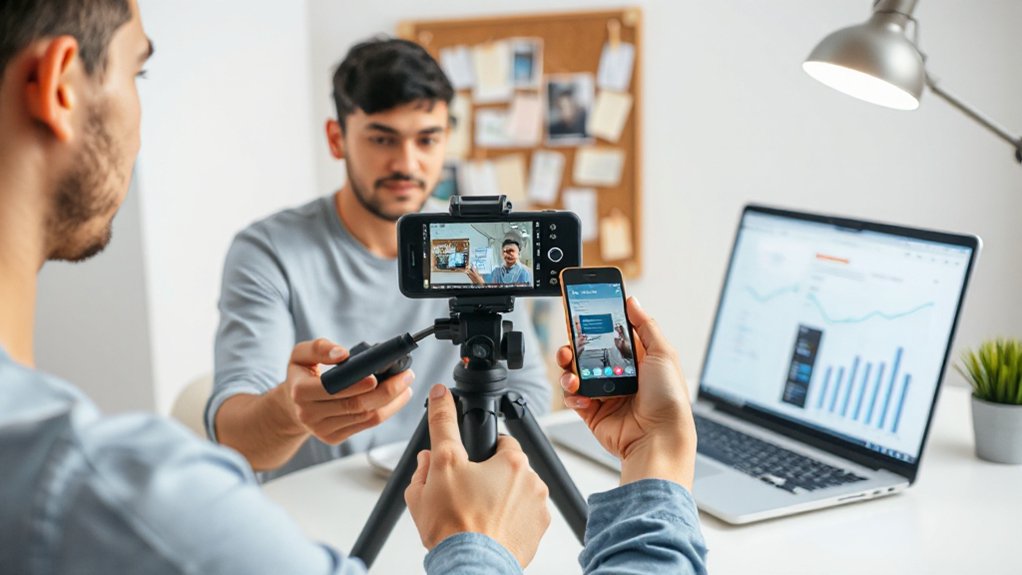
To get TikTok to index and rank your videos, you’ve gotta feed it keywords it can actually read and hear.
Put your main search phrase in bold on-screen text, say it out loud in the first few seconds, and mirror it in your captions.
When your text, voice, and captions all match the query, you’re signaling exactly what your video’s about—and TikTok’s more likely to push it in search.
Keyword-Rich On-Screen Text
Since TikTok now reads your visuals like metadata, the on-screen text you choose can make or break whether your video gets indexed and ranked in search. Treat it like mini SEO: lead with the exact query your audience types (“budget skincare routine,” “NYC thrift haul,” “easy gym warmup”).
Nail keyword placement by putting your primary phrase in the first frame, top third, and again on a step-by-step card if you’re doing tips. Keep it readable: high contrast, big font, no chaotic animations that blur letters.
Match wording to intent—how-to, best, near me, review—then support with 2–3 related terms on separate slides. Don’t stuff; be crisp and scannable.
Test variations weekly.
Spoken Phrases And Captions
Next, treat captions like metadata, not vibes.
Use tight caption strategies: lead with the keyword, add one clarifier (“for beginners,” “under $20,” “in 10 minutes”), then finish with a CTA that matches intent.
Keep it readable, use sentence case, and skip filler hashtags.
Your video will rank faster.
Write TikTok SEO Captions That Match Search Intent
Your caption’s not just vibes—it’s your SEO headline, so mirror the exact keyword phrases people type into TikTok search. Match the intent behind the query (how-to, review, “near me,” beginner) so viewers instantly feel like you’ve got the answer.
Do that, and your video lands in the right searches, pulls stronger watch time, and ranks harder.
Mirror Keyword Phrases
Even if your video is fire, TikTok won’t rank it for the right searches unless your caption mirrors the exact keyword phrase people type.
“Mirror keyword phrases” means you lift the search-intent wording—like “how to style baggy jeans” or “easy protein breakfast”—and drop it into your caption (and spoken hook) so the algorithm instantly matches your content to that query.
Don’t remix the phrase into something “creative.” Keep it literal, front-load it, and repeat it once naturally.
Example: “How to style baggy jeans for summer (3 fits)” beats “summer fit check.” Add one tight modifier (budget, beginner, 5 min) and skip vague hype.
This is search engine optimization for TikTok: precise wording, fast context, and zero confusion.
Use 1–2 mirrored phrases max, then let your hashtags support, not replace, the caption.
Align With Viewer Intent
Because TikTok search runs on intent, not vibes, you’ve got to write captions that answer the exact reason someone typed that query in the first place. If they search “easy iced matcha,” they want steps and ratios, not your latte art montage.
Lead with the promise: “Easy iced matcha (no clumps) in 30 seconds,” then support it with tight, searchable details: tools, measurements, and a quick outcome.
Match the intent type—how-to, review, comparison, or local—and keep your first line keyword-clean so it surfaces fast.
Boost audience engagement by adding one micro-CTA that fits the query: “Comment ‘matcha’ for my brands list.”
Maintain content consistency by repeating intent themes across posts, so TikTok learns your lane and ranks you higher.
Use Hashtags, Sounds, and Location to Boost TikTok SEO
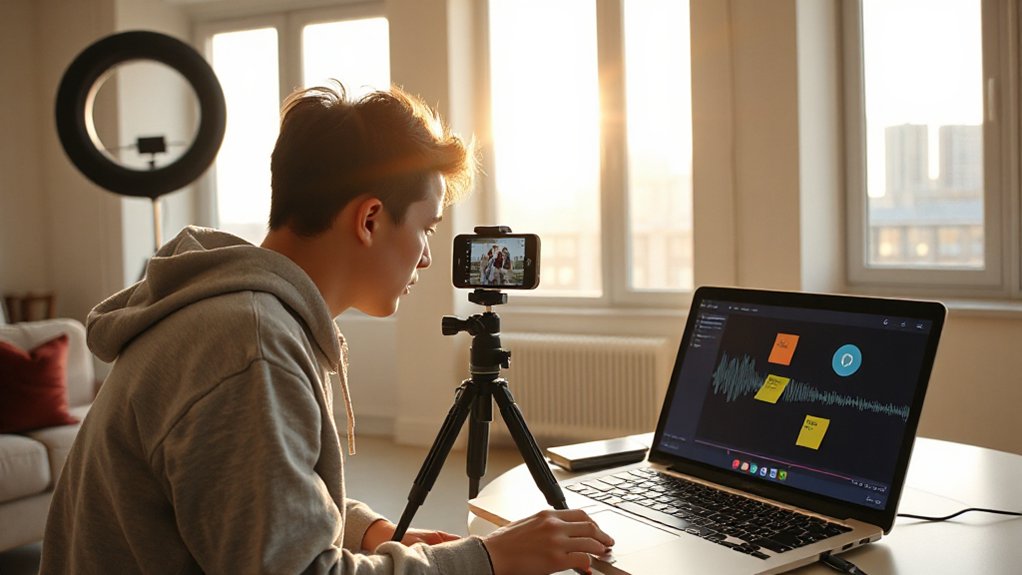
While TikTok’s search keeps getting smarter, you can still tip the algorithm in your favor by pairing the right hashtags, trending sounds, and location tags with the keywords you want to rank for.
Skip the hashtag dump: use 3–6 tags that match your niche and query intent (think #budgeteats, not #fyp).
Put your primary keyword in the caption first, then back it up with a couple of long-tail tags.
Layer in Trending sounds that already live in your content category, so you ride momentum without confusing the system.
Add Location tags when a place matters—city, campus, neighborhood—so locals searching “best coffee in Austin” find you.
Bonus: say the keyword on-camera to reinforce relevance.
Keep it clean, consistent, searchable.
Measure TikTok SEO With Search Views and Retention
Dialing in hashtags, sounds, and location gets you discovered, but your analytics tell you if TikTok’s actually ranking you. Open each post’s Traffic Source and watch Search Views: if they climb week over week, your keyword hooks, captions, and on-screen text match what people type. If Search stays flat, swap in clearer phrases, tighter niche terms, and redo your first 2 seconds.
Next, track retention like it’s your SEO score. High average watch time and strong completion rates signal relevance, so TikTok keeps serving you in search. Drop-offs at 1–3 seconds mean your intro’s off-trend or too vague.
Use Content creation checklists: promise, proof, payoff. Then refine audience targeting by testing formats, pacing, and CTA keywords for saves and shares.
Frequently Asked Questions
How Often Should I Post on Tiktok to Improve Search Visibility?
Post 3–5 times weekly to boost search visibility, and aim for daily when you can. Lock in Content consistency, watch Engagement frequency (comments, saves), and test trending keywords, hooks, and formats to stay discoverable.
Should I Create Separate Accounts for Different Niches or Audiences?
Yes—create separate accounts if your niches don’t overlap. 70% of users follow creators for one specific vibe, so Audience segmentation wins. Use Niche branding per account, keep hooks tight, and let trends target each crowd.
How Do Tiktok SEO Strategies Differ for Brands Versus Individual Creators?
You’ll optimize differently: brands lean on Brand storytelling, consistent keywords, and searchable product hooks; creators ride personality, niche phrases, and rapid trends. Use Influencer collaborations for credibility, while you prioritize authenticity, comments, and saves.
Can I Optimize Older Videos for Search Without Reuploading Them?
Yes—you can optimize older videos without reuploading by revitalizing your caption, hashtags, and keywords, plus updating Video metadata where possible. Use Content repurposing: stitch, duet, or clip highlights, then link viewers back with pinned comments.
What Tools Help Track Tiktok Keyword Trends Beyond the App?
You don’t need pricey software—use Google Trends, Exploding Topics, AnswerThePublic, Semrush, and Ahrefs to spot TikTok keyword trends. Pair keyword research with trend analysis, then map rising queries to hooks, captions, and hashtags.
Conclusion
You’re not just posting for vibes—you’re posting to rank. When you front-load trending keywords in your on-screen text, voiceover, and captions, TikTok can index you fast, even while your content feels effortless. Pair niche hashtags with trending sounds and a local tag, and you’ll show up in “how to” searches and For You feeds alike. Then watch Search Views and retention: chase what sticks, ditch what flops, and stay searchable.