How An Upgraded Website Generated More Traffic and Business For an Estate Agent in Hull
Table of Contents
Key Takeaways
🔑 The principles that drive website performance are the same whether you are operating in London or Hull. Mobile experience, page speed and clear conversion points matter equally in every market — the difference is that in smaller cities the competition for local search visibility is often significantly more winnable.
🔑 Local SEO is disproportionately powerful for estate agents outside major cities. The search volumes are lower but the competition is thinner and a well-optimised local presence can produce first-page visibility for valuable search terms within months rather than years.
🔑 In price-sensitive markets, trust signals on a website do more heavy lifting than anywhere else. Reviews, local credentials, staff profiles and genuine community knowledge are the things that convert a browser into an enquiry when the decision is not straightforward.
Hull gets overlooked. It has been getting overlooked for decades — by investors, by national media, by the kind of property commentary that fixates on London and Manchester and occasionally Bristol and calls it a comprehensive picture of the UK market. People who live and work in Hull tend to have complicated feelings about this, somewhere between mild irritation and a quiet pride in being part of a city that gets on with things without much fanfare.
The property market in Hull is genuinely interesting precisely because it operates so differently from the cities that dominate the conversation. Lower average prices, a strong rental demand driven by a large student population and a growing professional base, a regeneration story that has been building momentum since the City of Culture year in 2017, and a local buyer demographic that is more price-conscious and more locally rooted than the transient professional market that defines so much of urban property outside London.
It is also, from a digital marketing perspective, a market where the opportunity for a well-positioned independent estate agent is considerably more accessible than in the capital. Which is exactly what an estate agency we will call Pennine Property discovered when they finally got around to doing something about their website in the spring of 2025.
It was recognised that professional website design for estate agents is becoming essential for agencies that want to stand out, attract more clients and showcase their property listings effectively.
Pennine Property — A Business Built On Local Knowledge
Pennine Property had been operating in Hull for fourteen years. Two offices — one in the city centre, one in the Beverley Road area — a team of eleven, a solid reputation among local landlords and a lettings book that had grown steadily since the business launched. Sales had always been the quieter side of the operation, partly by design and partly by circumstance, but there was genuine appetite to grow that side of the business if the right conditions presented themselves.
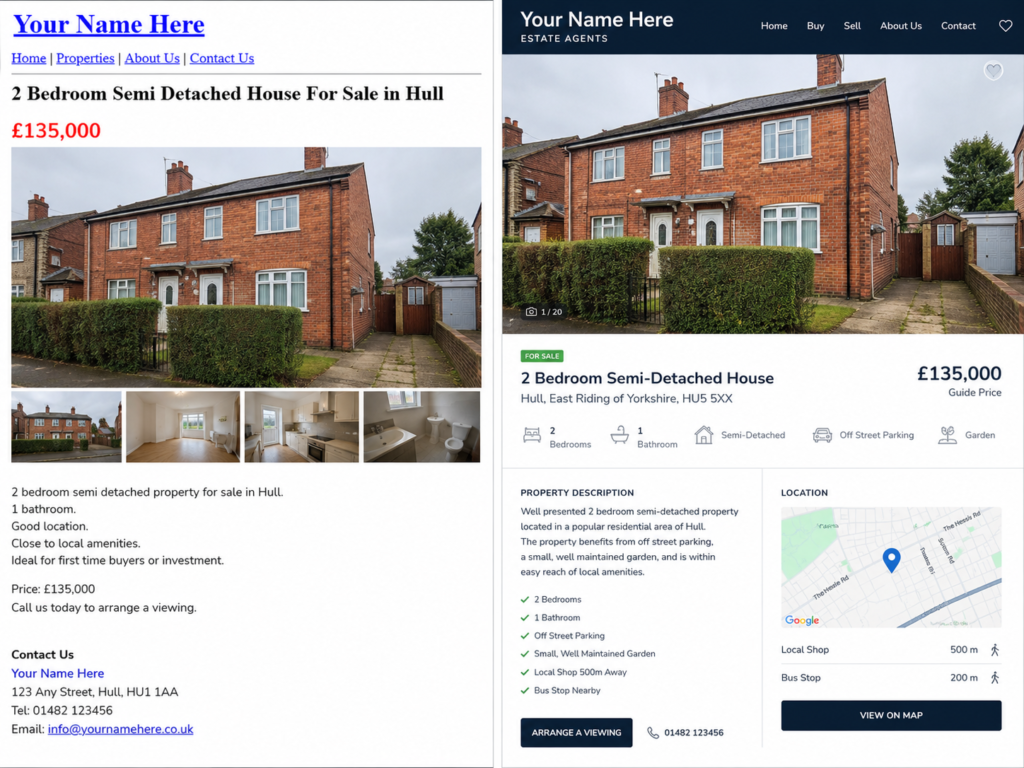
The website had been built eight years earlier by a local web design company that no longer existed. It was not offensive. The branding was recognisable, the property listings populated correctly from the CRM feed and the office addresses and phone numbers were accurate. Beyond that it was hard to say much positive about it.
It loaded slowly. It looked dated. On a phone it was essentially unusable. The property search returned results in a format that predated the smartphone era and had never been updated to account for the fact that the smartphone era had comprehensively arrived. The staff profiles — a critical trust element for any local estate agent — were four lines of text accompanied by photographs taken at the 2017 office Christmas party. The blog, which someone had clearly intended to maintain as a source of local property content, contained eleven articles, the most recent of which had been published in 2021.
None of this was keeping anyone at Pennine awake at night. The lettings side ticked along, the referrals kept coming and the website was, in the words of the managing director, Gary, “just kind of there.” It was not until a younger member of the sales team pointed out that three separate potential vendors had mentioned checking the website before deciding to go with a competitor that anyone started to take the question seriously.
The Audit — What Was Actually Happening
The starting point, as always, was data rather than opinion. What did the website’s actual performance look like and what specifically was going wrong?
The headline numbers were not encouraging. Monthly organic search traffic averaged three hundred and forty visits — a remarkably low figure for an agency with fourteen years of local presence and two physical offices. The Google Business Profiles for both offices were partially completed and had not been actively managed in years. There were no posts, the opening hours were incorrect for one office and several unanswered reviews — including two negative ones — were sitting publicly visible with no response from the business.
The mobile experience mirrored the problems seen at Hartley & Cross in London, though with some additional quirks specific to the age of the build. The site had been built before responsive design was standard practice and the mobile version was a scaled-down rendering of the desktop site rather than a properly designed mobile experience. On an iPhone the property listings page required horizontal scrolling to read. Horizontal scrolling. In 2025.
Local search visibility was the most striking finding. For the search term “estate agents Hull” — one of the most commercially valuable searches any Hull estate agent could appear for — Pennine Property was appearing on page three of Google results. Page three. For a business that had been trading locally for fourteen years and had two physical offices in the city. The newer, shinier websites of competitors that had been operating for a fraction of that time were sitting comfortably above them.
The reason was not mysterious. Search engines rank websites partly on the signals of trust, relevance and technical quality that the site itself projects. A slow, mobile-unfriendly site with thin content and a neglected Google Business Profile projects very few of those signals, regardless of how long the business behind it has been operating.
The Rebuild — Priorities and Decisions
The project was scoped in January 2025 and the new site launched in late March. The budget was deliberately modest by comparison with a London agency project — the Hull market operates on different economics and the investment needed to be proportionate to the returns a Hull agency could reasonably expect. That constraint was actually useful. It forced prioritisation.
Mobile First, Everything Else Second
The entire site was rebuilt with mobile as the primary design context. Property search rebuilt for thumb navigation. Results pages displaying cleanly on a vertical screen. Contact buttons that triggered a phone call or an email with a single tap. The kind of experience that feels obvious when you describe it and that an embarrassingly large proportion of estate agency websites in mid-sized UK cities still do not deliver in 2025.
Speed
Load time went from seven point two seconds — genuinely poor even by the standards of sites that had not been updated in years — to one point seven. The same combination of image optimisation, proper caching and a move to faster hosting that had worked in London worked equally well in Hull. Page speed is not a London problem. It is a problem everywhere and the fix is largely the same everywhere.
Staff Profiles Done Properly
This was the element Gary had been most reluctant to prioritise and that turned out to matter more than he had expected. Proper staff profiles — recent photographs, genuine biographical detail, specific areas of expertise, personal notes about local knowledge — were written for every member of the team and given their own well-designed pages on the site.
In a local market where a significant proportion of vendors and landlords are choosing an agent they expect to have a long-term relationship with, the people matter. Knowing who you are going to be dealing with, what they know and whether they feel like someone you can work with is part of the decision-making process in a way it often is not in a transactional London context. The new staff profiles gave the Pennine team a human presence on the website that the Christmas party photographs had entirely failed to provide.
Local Content — Hull Specific, Genuinely Useful
The blog was rebuilt as a genuine content resource rather than an afterthought. A programme of twelve articles was produced for the launch period, covering subjects chosen specifically for their search relevance and local utility — average house prices by Hull postcode, the best areas for first-time buyers in the city, a landlord’s guide to the Hull rental market, the regeneration projects changing specific neighbourhoods, school catchment guides for the areas the agency operated in.
This content served two purposes simultaneously. It gave search engines the kind of relevant, locally-specific material that helps establish a site’s authority for local search terms. And it gave potential vendors and landlords a reason to spend time on the site and develop confidence in the agency’s local knowledge before they ever picked up the phone. Both of those things matter. They just tend to be measured differently.
Google Business Profile — The Thing That Changed the Numbers Fastest
Both office profiles were claimed, completed properly and connected to the new website. Opening hours corrected. High quality photography of both offices uploaded. The unanswered reviews — including the two negative ones — were responded to professionally and promptly. A programme of weekly Google Business Profile posts was established, covering new listings, local property market updates and the new blog content.
The impact on local search visibility was the fastest result the project produced. Within five weeks of the updated profiles going live, Pennine Property had moved from page three to the top half of page one for “estate agents Hull” and was appearing in the local map pack — the three-listing block that appears above organic results — for several area-specific searches including “estate agents Beverley Road” and “letting agents Hull city centre.”
The Results — Six Months On
By September 2025, six months after the new site launched, the numbers showed a picture that had exceeded what Gary had expected when the project started.
Monthly organic search traffic had increased from three hundred and forty visits to just over one thousand one hundred — a growth of more than two hundred and twenty percent. The quality of that traffic had improved alongside the volume. Time on site was up, bounce rate was down and the proportion of visitors who engaged with property listings or contact pages — the actions that indicate genuine intent rather than casual browsing — had increased significantly.
Valuation requests through the website were running at three times the pre-launch monthly average. New lettings instructions in the six-month period were up thirty-one percent year on year. Sales instructions — the side of the business Gary most wanted to grow — were up twenty-eight percent, with the staff profiles and the local content articles both cited by new clients as things that had influenced their decision to choose Pennine over competitors.
The two negative Google reviews that had been sitting unanswered were still there — they cannot be removed — but the professional responses that had been added and the subsequent positive reviews the team had actively encouraged had shifted the overall rating from three point eight to four point six stars. That shift in star rating alone is estimated to have had a material impact on the click-through rate from Google search results — studies consistently show that local business ratings below four stars produce significantly lower click-through than those above four point five.
“I honestly thought the website was the least of our problems,” Gary said when we reviewed the numbers in October. “Turns out it was causing most of them.”
What Hull Teaches Us That London Cannot
The Pennine Property story is valuable not just as a case study in website performance but as an illustration of something the London-centric bias in digital marketing commentary consistently underplays. The opportunity for smaller city estate agents to dominate their local digital landscape is, in many respects, greater than it is for London agencies.
The search volumes are lower, yes. But the competition is thinner, the cost of paid advertising is lower, the barrier to first-page organic visibility is more achievable and the community trust signals — local knowledge, staff recognisability, genuine area expertise — carry more weight in the decision-making process than they do in a market defined by turnover and transaction volume.
Getting a website right in Hull is not a smaller version of getting a website right in London. In some ways it is a more straightforward proposition — and the return on doing it properly, relative to the investment required, can be just as compelling.
Frequently Asked Questions
Is local SEO different for estate agents in smaller UK cities compared to London?
The principles are identical but the competitive landscape is very different. In London, first-page visibility for generic estate agency search terms is extremely competitive and often requires sustained long-term investment to achieve. In cities like Hull, Sunderland, Preston or Derby, the same investment produces faster results because fewer competitors are making that investment consistently. The fundamentals — Google Business Profile optimisation, locally relevant content, technical site health, review management — are the same everywhere. The timeline to meaningful results is often considerably shorter outside major cities.
How important are Google reviews for a local estate agent’s website performance?
Critically important, in two distinct ways. Review quantity and quality directly influence where a business appears in Google’s local map pack results — the highly visible three-listing block that appears above organic results for local searches. They also influence click-through rates from those results, with businesses rated above four point five stars consistently outperforming lower-rated competitors on clicks even when they appear in the same position. For estate agents, where trust is a fundamental part of the selection decision, actively managing and responding to reviews is one of the highest-return activities available — and one of the most consistently neglected.
Should a smaller estate agent outside London bother with a content strategy?
Yes — and arguably more so than a London agency, for a reason that is often missed. In a smaller city market, genuinely local content faces less competition for search visibility than it does in London, where every conceivable local search term has been targeted by multiple well-resourced competitors. An estate agent in Hull who produces genuinely useful, locally specific content about Hull’s property market, neighbourhoods and buying process has a realistic chance of ranking prominently for searches that represent real commercial value. That opportunity is harder to access in London and considerably more accessible in mid-sized cities where the content gap between what people are searching for and what local businesses are actually producing remains wide.
NB: ‘Pennine Property’ is not the actual name of the client, due to NDAs, we cannot name the actual clients that we work with unless they agree.