

Table of Contents
You need a one page marketing strategy you can execute tomorrow: pick one measurable goal (increase bookings from A to B by a date), define one clear customer segment with pains and triggers, and write a one-sentence promise with 3 proof points. Choose 2–3 channels with one weekly action each, map a simple funnel (attract, capture, close, retain), add one lead magnet and one core offer with clear CTAs, then track Leads, CPL, CAC, LTV, and Close Rate—next, you’ll see how to fill the template fast.
Key Takeaways
- Set one measurable goal: increase a specific metric from A to B by a date, tracked in CRM, POS, or analytics.
- Define one clear customer segment: pains, triggers, decision criteria, budget, and a one-sentence promise they instantly understand.
- Lock your offer and value proposition: what you sell, who it’s for, the outcome, timeframe, and three proof points.
- Choose 2–3 channels only, assign one weekly action per channel, and maintain consistent brand voice and visuals across all touchpoints.
- Map a simple funnel: attract, capture, close, retain; pick one conversion action per stage and track leads, CPL, CAC, LTV, and close rate.
Fill In the One-Page Marketing Strategy Template (Example Included)

In 15 minutes, you can draft a one-page marketing strategy that clarifies who you’re targeting, what you’ll say, and how you’ll win attention. Open your template and fill it top to bottom: offer, audience, message, channels, budget, timeline, and metrics.
Start with market segmentation: pick one clear segment, list its pains, triggers, and decision criteria, then write your promise in one sentence.
Next, lock branding consistency: define your tone, visual rules, and three proof points you’ll repeat everywhere. Example: “Mobile car detailing for busy parents; 60-minute clean; text-only booking.”
Choose 2–3 channels, add one weekly action per channel, and set simple tracking (calls, clicks, bookings). Keep each line specific enough to execute tomorrow.
Set One Goal for Your One-Page Strategy
Before you pick channels or tactics, set one measurable goal for this one-page strategy so every line points to the same outcome.
Choose a single metric you can track weekly, like booked consultations, first-time purchases, email sign-ups, or qualified leads.
Write it as: “Increase X from A to B by DATE,” and add how you’ll measure it (CRM, POS, analytics).
Then pressure-test it: does this goal match your current constraint (awareness, conversion, retention), and is it realistic with your budget and capacity?
Use your target audience and brand voice as filters—if a tactic won’t move this metric with the people you serve, cut it.
Finally, define one leading indicator (traffic, click-through, reply rate) so you can adjust fast without changing the goal midstream.
Write Your Ideal Customer Profile (No Jargon)
Once you’ve picked a single goal, write down who you’re trying to help in plain, specific language—so specific you could spot them in a room. Describe their job, situation, and what they’re trying to get done this month, not “demographics.” Add 2–3 qualifying details: budget range, decision authority, and where they spend time (neighborhood, online communities, suppliers).
Next, capture Customer behavior: what triggers their search, what they compare, what slows them down, and what proof they look for. List the top three objections you hear and the common words they use.
Then scan Market trends: new regulations, seasonal shifts, rising costs, or platform changes that affect them. Keep it on one paragraph and update it quarterly.
Draft a Value Proposition That Wins Business
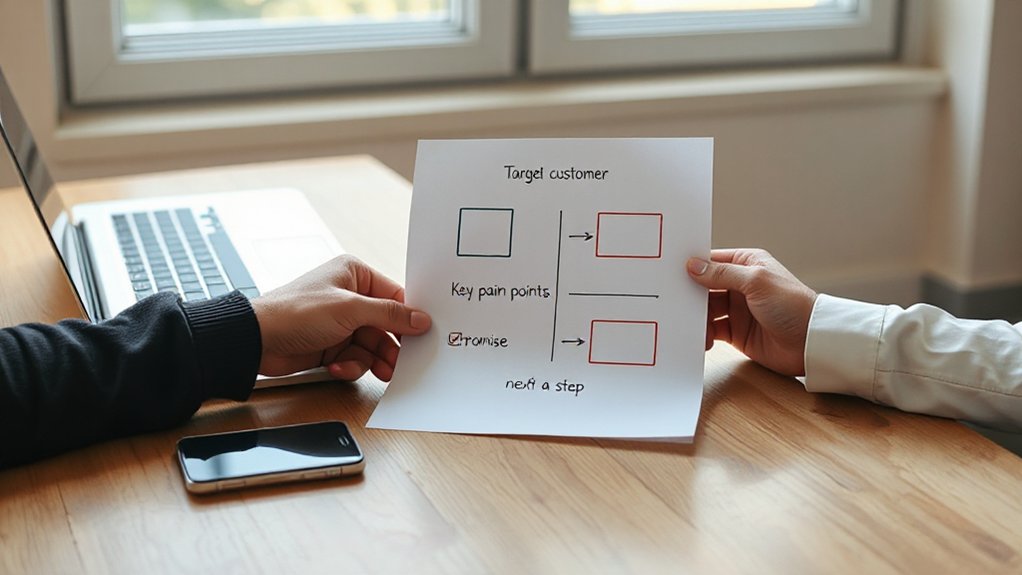
Because your prospects don’t buy features, they buy a clear outcome, you need a value proposition that states exactly who you help, what result you deliver, and why you’re the safest or fastest choice.
Start with your ICP and write one sentence: “I help [specific customer] achieve [measurable result] in [timeframe] without [top frustration].” Then add proof: a differentiator you can defend (process, guarantee, expertise, niche focus). Keep it concrete—numbers, timelines, and constraints beat adjectives.
Use it to sharpen Brand positioning: if you can’t exclude, you can’t stand out. Finally, align every offer detail to this promise so delivery matches marketing; that consistency builds trust and long-term Customer loyalty.
Test by asking: would a competitor credibly say this?
Sketch the Funnel: Attract → Capture → Close → Retain
Now you’ll sketch your funnel from Attract to Capture to Close to Retain, and map what you want the buyer to do at each stage.
Pick one key conversion action per step—click, opt-in, book a call, buy—so you can measure and improve it fast.
Then define the retention touchpoints that keep customers engaged after the sale, like onboarding, check-ins, and upsell triggers.
Map Each Funnel Stage
If you don’t map your funnel end to end, you’ll waste effort in the wrong places and wonder why leads stall.
Draw four boxes: Attract, Capture, Close, Retain, then list what your customer thinks, feels, and needs in each stage.
Use Customer segmentation to map distinct paths for your top audiences, not a one-size-fits-all journey.
For Attract, align channels and messages to each segment’s problems and use Brand storytelling to signal credibility and fit.
For Capture, note what information prospects require before they’ll engage further and where doubts appear.
For Close, map stakeholders, timing, and objections so you can prepare proof and follow-up sequences.
For Retain, map moments that create loyalty, referrals, and repeat demand.
Keep this map on one page.
Choose Key Conversion Actions
Once you’ve mapped each stage, pick one primary conversion action for Attract, Capture, Close, and Retain so every tactic drives a measurable next step.
For Attract, choose the action that signals intent—read a pillar post, watch a demo clip, or visit a landing page driven by Brand storytelling.
For Capture, commit to one opt-in: email signup, quote request, or free consult booking, then align forms and CTAs to your Customer segmentation so leads self-identify.
For Close, define one “yes” action: checkout, paid deposit, or signed proposal; remove extra steps and match your offer to the segment’s top pain.
For Retain, choose one action that proves ongoing value—repeat purchase, upgrade, or referral request—and track it weekly.
Define Retention Touchpoints
Where do customers go right after they buy—and what do you want them to do next? Define retention touchpoints so your funnel doesn’t stop at Close.
Map the first 30 days: confirmation email, onboarding checklist, “how to use it” video, and a fast support path. Then schedule recurring nudges: usage tips, replenishment reminders, feature highlights, and review requests tied to clear triggers (day 7, first win, reorder window).
Add one human moment—thank-you note, check-in call, or live Q&A—to increase Customer loyalty. Track each touchpoint’s goal: reduce refunds, drive repeat purchase, earn referrals.
Use Engagement strategies that match your channel mix: email sequences, SMS for time-sensitive prompts, and retargeting for lapsed buyers. Keep it simple, measurable, and consistent.
Pick Channels That Fit Your Funnel and Customer
Because your marketing funnel has distinct jobs at each stage—attract, capture, nurture, and convert—you should choose channels based on the customer’s behavior and intent, not what’s trending. Map where they already look for answers, compare options, and ask for recommendations, then match each stage to the best channel.
For attraction, lean on SEO and short-form platforms, but don’t bet everything on Social media algorithms; diversify with local search and referral sources.
For capture, use a focused landing page, lead magnet, or booking link wherever attention lands.
For nurture, email and SMS give you control and repeat reach.
For conversion, prioritize sales calls, demos, retargeting, and review platforms that reduce risk.
Add Influencer partnerships only when audiences overlap and tracking is clear.
Plan Weekly Content for Your One-Page Strategy
Now you’ll turn your one-page strategy into weekly execution by setting clear content themes that match each stage of your funnel.
Assign one theme per day (or per week) so you always know what to create, from awareness tips to proof and offers.
Then lock in a simple posting cadence you can sustain, and batch your drafts so you stay consistent without scrambling.
Weekly Content Themes
Even if your one-page strategy feels solid, your marketing will stall without a weekly rhythm that turns ideas into consistent execution.
Pick 4–6 repeatable themes that map to your funnel: awareness, education, comparison, conversion, and retention.
Assign each theme a clear promise, so you know what problem you’ll solve every time you create content.
Lock in branding consistency by tying each theme to a specific message angle, visual cue, and voice guideline.
Build social proof into at least one theme: customer wins, testimonials, before-and-after results, or behind-the-scenes delivery updates.
Create a simple theme bank with 10 prompts per theme (questions, myths, checklists, case notes).
When you plan the week, pull prompts that match current offers, objections, and seasonal needs, and keep everything aligned.
Simple Posting Cadence
Weekly themes give you the “what,” but a simple posting cadence gives you the “when” so your strategy shows up on the calendar. Pick a sustainable rhythm you can keep for 90 days: 3 social media posts, 1 email, and 1 short-form video per week. Lock the days (Mon/Wed/Fri posts, Tue email, Thu video) so you’re not deciding daily.
Build your content calendar in 20 minutes: list your weekly theme, then assign one post type to each day—teach, prove, invite. Batch-create on one block (Friday afternoon or Monday morning), schedule everything, and leave one “flex slot” for timely updates.
Track two metrics: saves/shares for value, and clicks/replies for intent. If you miss a day, don’t double-post—reset next week.
Choose One Lead Magnet to Capture Leads
How do you turn casual visitors into qualified prospects without chasing them? You choose one lead magnet and make it impossible to ignore.
Start with Customer segmentation: pick your most profitable segment, name their top pain, and match it to a quick win they’ll trade an email for.
Use Brand storytelling to frame the magnet as the next chapter: “Here’s how clients like you stopped X and achieved Y.” Keep it specific and finishable in 10 minutes—checklist, template, calculator, or mini guide.
Put it on your homepage, in your bio link, and at the end of your best posts.
Ask only for email, then confirm with a short thank-you page.
Track opt-in rate weekly and refine the headline.
Create One Core Offer Plus Clear CTAs
Then add clear CTAs everywhere the lead might hesitate: one primary button (“Book a 15-minute consult” or “Start your first package”) and one secondary option (“Reply with a question” or “See what’s included”).
Place CTAs after benefits, testimonials, and FAQs.
Reduce friction with short forms, upfront expectations, and a risk-reducer like a guarantee or bonus.
This structure boosts Customer engagement.
Track 5 Numbers: Leads, CPL, CAC, LTV, Close Rate
Because you can’t improve what you don’t measure, track five numbers that tell you whether your one-page strategy actually prints profit: Leads, CPL (cost per lead), CAC (customer acquisition cost), LTV (lifetime value), and Close Rate.
Start with Leads: count opt-ins from each traffic source and each Market segmentation group.
Next, CPL tells you which channels deserve budget; cut anything rising without better lead quality.
Then calculate CAC by dividing total sales costs by new customers, and compare it to LTV—if LTV isn’t at least 3× CAC, fix your offer, pricing, or onboarding.
Close Rate reveals whether your page, follow-up, and Brand storytelling move prospects to act.
Track weekly in one simple sheet, and tie every tweak to one metric only.
Update Your One-Page Strategy Every Month
When do you know it’s time to tweak your one-page marketing strategy? Every month, set a 30-minute review to compare your five numbers to last month and your targets. If leads drop, CPL rises, or close rate slips, adjust fast—don’t wait for a quarter.
Start with Market segmentation: check which segments converted, which stalled, and what changed in their objections, channels, or timing. Then refine your offer and message to match the winning segment.
Next, revisit Brand positioning: confirm your differentiation still beats competitors and your proof supports it. Update one page only: audience, promise, key channels, weekly actions, and metrics.
Finally, pick one experiment for the month (new angle, new landing page, or retargeting), and define success before you launch.
Frequently Asked Questions
How Much Should I Budget Monthly to Run This One-Page Marketing Strategy?
Budget $500–$2,500 per month to run it effectively: $200–$800 for Content automation tools and freelancers, $150–$700 for ads/testing, and $150–$1,000 for influencer outreach (gifting, micro-fees, tracking).
If you’re bootstrapping, start at $300 with sweat equity and reinvest 20–30% of revenue growth.
Track CAC, conversion rate, and LTV weekly, then scale the best channel only.
Do I Need Marketing Software or Can I Manage Everything With Spreadsheets?
You can manage everything with spreadsheets—at first. But here’s the twist: once leads, follow-ups, and posts pile up, cracks show fast.
Start with spreadsheets for tracking KPIs, contacts, and tasks.
Add free/cheap tools only when you need Marketing automation for email sequences or reminders, and Content scheduling to batch posts weekly.
Set a threshold: if you miss follow-ups or deadlines twice, upgrade immediately.
How Long Until I See Measurable Results From This Strategy?
You’ll usually see measurable results in 4–8 weeks, with stronger, steadier gains by 90 days.
You’ll move faster if you start with clear Customer segmentation, then tailor offers and messages to each segment.
Build a weekly Content calendar and publish consistently, tracking leads, conversions, and revenue by channel.
You should review metrics every 7 days, cut what’s underperforming, and double down on what’s working.
What Should I Outsource Versus Handle In-House as a Small Business?
Outsource specialized, time-draining work; keep core, customer-facing work in-house. You should outsource design, video editing, SEO, paid ads setup, and bookkeeping—tasks needing expert tools and constant updates.
You should handle strategy, brand voice, Content creation topics, and Customer engagement yourself, because they require intimate customer knowledge.
If you can’t document a process or quality slips, outsource it. If it shapes trust and offers, keep it internal.
How Do I Adapt This Strategy for Seasonal Demand or Slow Periods?
You adapt it by building a flexible quarterly plan with triggers for spikes and dips. Retailers can see holiday sales jump 20–40%, so you can’t wing it.
Use demand forecasting from past sales, web traffic, and lead times to set inventory, staffing, and ad budgets.
Run seasonal promotions early, then shift to retention offers during slow weeks.
Pre-schedule content, negotiate vendor terms, and track weekly KPIs.
Conclusion
You don’t need a 40-page plan to grow; you need one page you’ll actually use. When you trade scattered tactics for a single goal, a real customer profile, and a sharp value prop, your marketing stops guessing and starts converting. Keep the funnel simple: attract, capture, close, retain. Pick one lead magnet, one core offer, and clear CTAs. Track five numbers monthly, then adjust fast. Complexity feels safe; clarity wins.